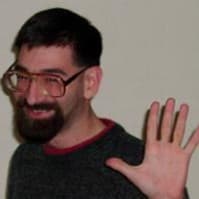
David: The Bearded One
he/they
4.8
(6)
Timezone
Language
Identity
About David: The Bearded One
I learned to play my first TTRPG (Basic D&D) at age 9, almost fifty years ago. Within three years of that, I started GMing, beginning with D&D, Gamma World, and Traveller. Since that time, I have played scores of different TTRPG systems, (and starting around age 19, several LARP systems as well), and I haven't paused for more than a couple of months since then. Currently, I run a monthly D&D 5e (2014) campaign and a weekly Masks: New Generation PbtA campaign for my offline friends. But I have even more stories I want to share with the world at large!
At a glance
1 year on StartPlaying
3 games hosted
Highly rated for: Storytelling, Beginner Friendly, Creativity
$25 per session
Featured Prompts
My favorite shows/movies are
Favorite TV shows: Buffy the Vampire Slayer, Firefly, The Good Place Favorite Movies: Amadeus, Everything Everywhere All at Once, Back to the Future, Amelie, Star Wars (1977), Casablanca
My favorite system of all Time is
...impossible to pick from all the wonderful options. For gritty crunch, I like GURPS 4th edition. For easy narrative flow, I like Powered by the Apocalypse and FATE games. For simulationist immersion, I like diceless systems such as Amber and most LARP systems.
When I'm not running games I'm...
...writing fiction. Most of what I write is genre fiction (sci-fi, fantasy, horror), but I'm not opposed to more elevated literary tropes. Professionally, I am a sign language interpreter specializing in medical settings.
How David: The Bearded One runs games
I view Role Playing Games as a medium to tell a story. The narrative is almost always of paramount importance, whether that is the plot of defeating whatever big bad is threatening the area or whether that is the story of an individual character's redemption or fall from grace or coming of age. The times when the narrative takes a back seat are those times when embodying who a character is becomes the focus of the story. Exploring who a character is in the dark (literal or metaphorical) can be just as dramatic in a game, and learning a character's deep, dark secrets can help to push a narrative forward, or it can help to reveal to hidden personality traits of other characters nearby. What I usually do not focus on is the gritty tactical realism of combat nor the detailed steps of a strategic war plan. Battles large or small are just rungs in the ladder to telling a compelling story about interesting characters. I would rather hand-wave away the blow-by-blow details of fights than breeze past important character developments. If a character might grow or change by being involved in a combat, then that is what makes the combat important, not the mere fact of the obstacle to be overcome.
Featured Prompts
I once ran a session...
...of In Nomine during which the characters were planning and executing a break-in of an office building in order to steal documents and cover their tracks with arson. The glorious part was that the entire session was handled by simple conversations and actions which did not require any dice rolls.
My favorite trope is...
...the "Heel-Face Turn". This is when a villain is compelled by their conscience or other factors to reject their villainous side and at least try to become a hero. A lot of the LARP characters that I play employ this trope, and I love it when PCs in my TTRPG games have this in their backgrounds.
Rules are...
...a means to an end. The end I aim for is telling a compelling and powerful story. If the rules are slowing down or getting in the way of the story, then I am not going to be using those rules as written. I want rules that encourage narrative flow and character development.
David: The Bearded One's ideal table
Featured Prompts
I love it when a player
...has their character act in a way that furthers the narrative but harms their own safety or health. Playing to your character's flaws and weaknesses is the opposite of MinMaxing and is one of the best things a player can do at my table.
I think it's a red flag when players...
...are trying to "win" the scenario without addressing their characters' developments as part of the story. RPGs are about telling a compelling story, not "winning". Players who want to just make their characters become richer and more powerful are a bad fit for my table.
My table is not the place for...
...any sort of disruptive behavior. PCvPC conflicts should be rare, and players antagonizing other players should never happen at my table. That includes any sort of homophobia, transphobia, racism, ableism, or any other form of bigotry.
David: The Bearded One's Preferences
Systems
Platforms
Game Mechanics
Themes