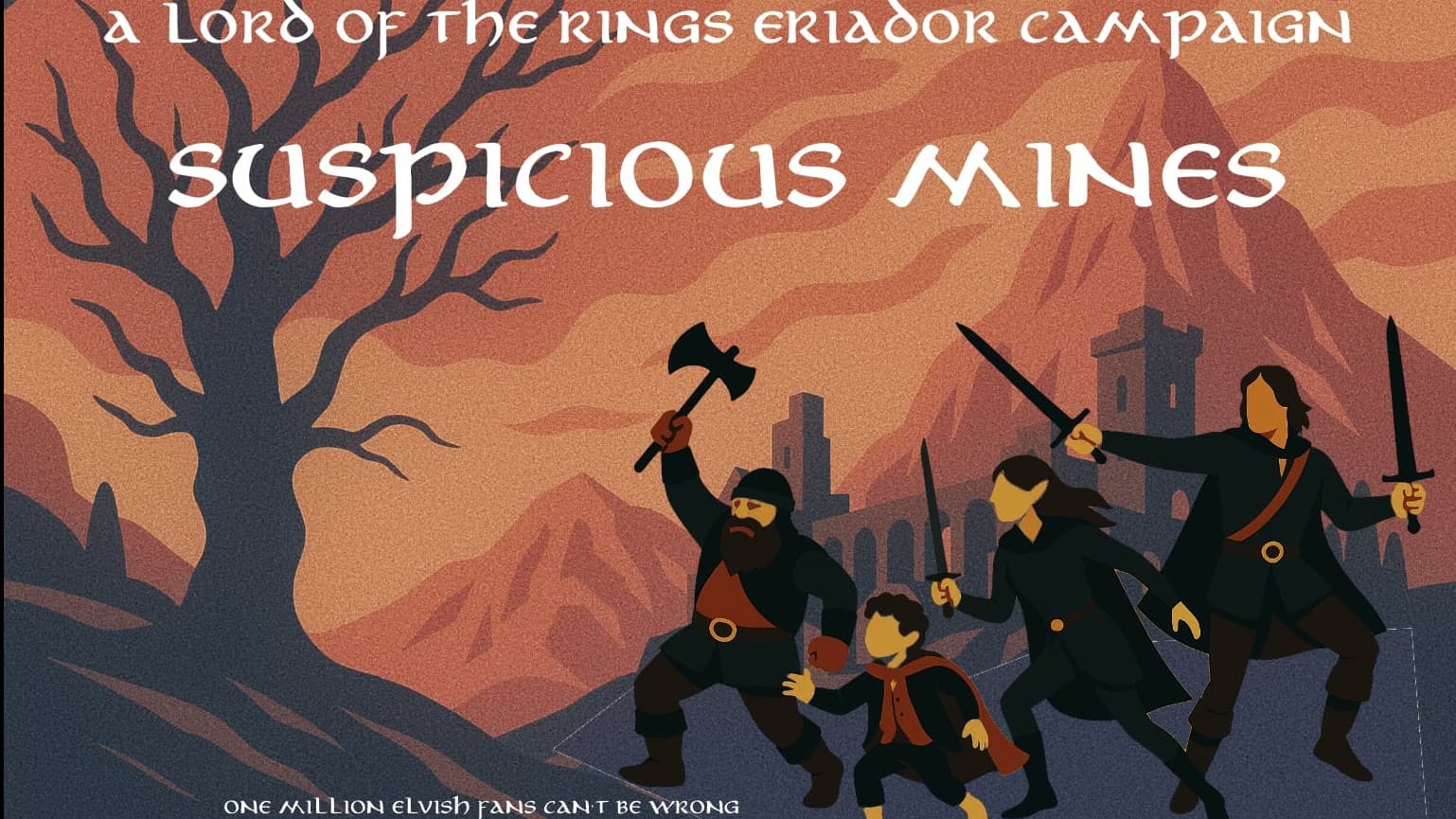
Suspicious Mines: 50 Million Elvish Fans Can't Be Wrong
Will your party serve the needs of the Free Peoples or succumb to the shadow? It starts with missing dwarves and a rumor at the Prancing Pony.
$15.00
/ Session
Details
6 players following this game
Weekly / Tuesday - 5:00 PM UTC
Session Duration / 2–3 hours
Campaign Length / 6–10 Sessions
1 / 6 Seats Filled
Report Adventure

StartPlaying Money Back Guarantee
If your game doesn't happen, we guarantee a refund. Just reach out to StartPlaying Support. Refund Policy
Meet your party members
1/6
About the adventure
Experience Middle-earth in roleplaying form, the way it feels in the books: a long road, a small company, and real stakes. Suspicious Mines is high fantasy roleplaying set in the years between The Hobbit and The Lord of the Rings. Your party never changes the canon of the novels, but your work can feel like it's making things a little easier, or harder, for the heroes who come later. The game runs in four phases. Journey: you travel the wild in hexcrawl style and find out what the road costs. Council: social scenes where what you say carries real stakes. Adventure: exactly what it sounds like. Fellowship: downtime, three times a year, including Yule, when the company is holed up for the winter and gets extra options. Combat is deadlier than D&D and usually best avoided. You can be mortally wounded, which could kill your character and makes them harder to heal if they survive. The One Ring rules keep that Middle-earth feel front and center, so it plays like Middle-earth and not like a generic fantasy fight. We start in the ruins of Eriador and travel to Rivendell, the ruins of Ost-in-Edhil, and Tharbad, and might even get into Moria. If you know the legendarium, you'll recognize famous parts of Middle-earth as you explore them. If you don't, you won't miss a thing. It's theater of the mind, and you don't need to be a Tolkien scholar, or have seen the movies, to have fun. Song is a real tool in the rules, and I lean on it more than most GMs do. While you don't have to sing, you could if you felt like it, or you could play a song. The title is a nod to Elvis. Will your party serve the needs of the Free Peoples or succumb to the shadow? It starts at the Prancing Pony, where word is that a group of dwarves who went into the Weathered Hills has gone missing.
Game style
Hexcrawl / Exploration
Combat Lite
Roleplay Heavy
Rule of Cool (RoC)
Sandbox / Open World
Theater of the Mind
Game themes
Meet the Game Master

5.0
(8)
2 years on StartPlaying
10 games hosted
Highly rated for: Rule of Cool, Creativity, Inclusive
About me
I enjoy all kinds of board games and RPGs. As a GM I prefer theater of the mind to very detailed simulations. I enjoy puzzles and narrative arcs that are not simply combat based. I've been playing for many years. I enjoy virtual table tops but I tend to use very simple elements, I think sometimes virtual table tops make RPGs feel too much like an arcade game. I'm told I bring a lot of humor (mostly not twisted), to even the darkest most dangerous encounters and story arcs without robbing the story of their emotional heft.
View Profile →Character creation
Creating your character
Tools: Build your character on Free League Unbound (https://www.freeleagueunbound.com/characters/), or send me a PDF of your sheet. Both are keyed into FoundryVTT, so either works. Creation Timing: Please make your character before the first session. One-shot players may tweak their characters before play begins. Campaign players should come prepared with a backstory and a short start-of-session introduction. Session Zero: Come ready to play your character. After we look at everyone's characters together, we may adjust them. Allowed Sources: We use Free League's source material. Anything else is welcome with approval, and the GM reserves the right to issue polite confusion in response to individual requests. Where You Begin: Your story starts in the ruins of Eriador, with word at the Prancing Pony of a missing party of dwarves.
What to expect
Preparing for the session
You need email, a good computer, a decent broadband connection, and a camera with a mic (we would like to see your face during role playing encounters). We use Google Meet on a smartphone for audio and video during play, so your computer can run FoundryVTT in your web browser. You'll join by link, and you don't need a Google account. I'll let you in at the start of each session. You should be familiar with FoundryVTT, or at least willing to learn how to roll dice, update your character sheet, and move your character on the map. I use Discord a lot when people need "out of game" assistance but not during game play.
What Larry brings to the table
What You Get • Fully prepped virtual tabletop sessions, with maps and every phase ready to go: Journey (hexcrawl-style travel through the wild), Council (social scenes where words carry stakes), Adventure, and Fellowship • FoundryVTT One Ring Game World (Free League official) game table with a lot of Foundry VTT ToR Community compendium art, and art purchased from creators. Great visuals that match the tone of Middle-earth. • Character tools and quick references to keep things moving GM Style • Middle-earth experienced in roleplaying form, as theater of the mind • Deadly combat that is usually best avoided • Famous places explored without changing the canon of the books • The One Ring rules keep the feel of Middle-earth front and center
Homebrew rules
I don't run any house rules for The One Ring. If you're curious about things like playing an Istar (I don't allow this) or adventuring in the First Age, I share info about a compendium of homebrew material on request, though I don't really think to use most of it myself. I also draw on the narrative material from my many out-of-print collection of high fantasy on theme resources to make the world feel more like a sandbox. I don't use much of it in my short-arc sessions, but when we go off script i'll reach for it. The adversaries and mechanics are all The One Ring 2e official.
Equipment needed to play
Computer
Internet
Microphone
Pen & Paper
Physical Dice
Webcam
Mobile Phone
Platforms used
Safety
How Larry creates a safe table
We use Lines and Veils with an X-Card pause and discuss mechanic. The tone of this game is the Long Defeat: the Shadow is growing, and standing against it matters even when winning is not guaranteed. We use Free League's source material. Lines are hard boundaries the story will not cross. Veils are topics that may exist in the world but happen off-screen or are handled with discretion. Lines: gratuitous violence (peril and combat are part of the game, but no excessive gore or detailed descriptions of suffering); explicit sexual content or non-consensual situations; harm to children or animals; and real-world prejudices such as racism, sexism, homophobia, and transphobia. Veils: romantic relationships (tasteful, fading to black); torture or extreme suffering (implied, not described); the death of major NPCs (the emotional impact matters, not graphic detail); and despair, loss, and the Shadow's corruption (present in the tone, handled with discretion). Orcs and goblins: in this game they are creatures completely corrupted by Morgoth and Sauron. They are not born, and they are not a people. They are one-dimensionally evil on purpose, and they stand for the Shadow itself, not for any real-world group. The Free Peoples are ethnically diverse, as in Tolkien's source material, and so is our game. X-Card: say "X," tap the table, or send a message in chat, and the scene stops or shifts immediately, no questions asked. Pause and check-in: ask for a brief pause to clarify or adjust a situation. We'll review these boundaries together at session zero and add any you want. You always decide what your character does.
Content warnings
Safety tools used