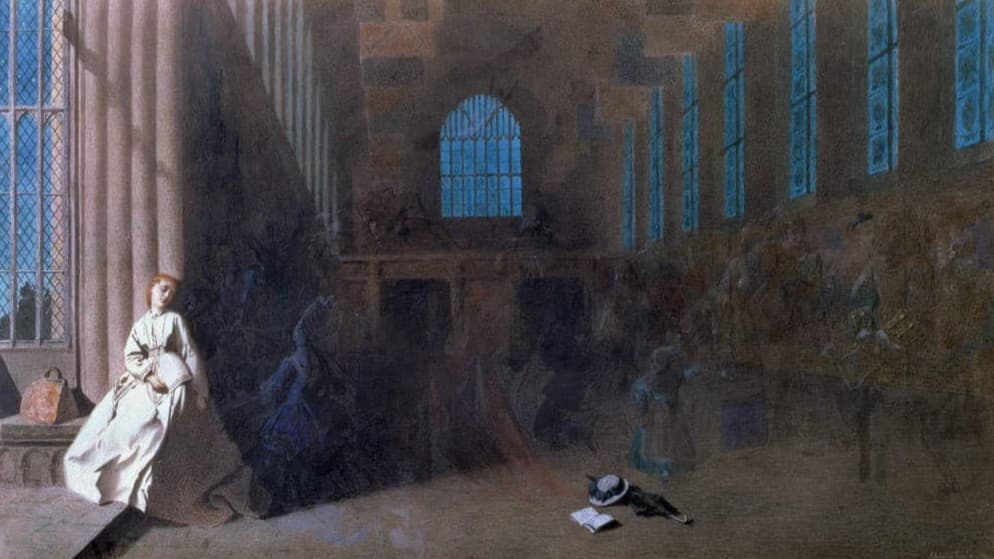
Image by Adelaide Claxton, 1868
Bluebeard's Bride: A Dark Fairytale for Disturbed Individuals
You are recently wed to the lord of this manor -- or, at least, the sum of your parts is. Discover his secrets. Open the final door, if you dare.
TYPE
SYSTEM
LANGUAGE
EXPERIENCE
AGE
$10.00
/ Session
Details
Play by Post (Asynchronous)
Billed Weekly / Sunday - 1:00 AM UTC
Session Duration / 3–4 hours
3 / 5 Seats Filled
Report Adventure

StartPlaying Money Back Guarantee
If your game doesn't happen, we guarantee a refund. Just reach out to StartPlaying Support. Refund Policy
Meet your party members
3/5



About the adventure
Set in a bleakly Gothic 17th century Europe (France, perhaps? It's hard to say), you find yourself roaming the many rooms of your newly betrothed, Bluebeard, the lord himself having taken leave to attend to his feudal affairs. What you discover is dark, dark beyond anything you'd ever imagined. Your husband, for all his charms, is a monster, and the truth of his monstrosity bleeds from every room his keys, freely given, can open. He gave you but one command: One key must never be used. One room must never be opened. It is, ultimately, your choice. You play not as many, but as one. Facets of the Bride's psyche, the Sisters operate as female archetypes, representing all of the women a single woman must hold to survive in this world. They will at times conflict, but at others they will protect one another, and their individual strengths make of the Bride a competent woman placed into impossibly cruel circumstances -- supposing they do not shatter, one by one. A Powered by the Apocalypse game, Bluebeard's Bride relies on a small number of story-forward Moves that advance the plot. A 2d6 system of hit, mitigated hit and miss, your actions will never have a null result, only consequences, for better or worse. You investigate the horrors of your husband's passing, take on Trauma, and choose between faithfulness and disloyalty, over and over again. This game will be run asynchronously, Play-by-Post, over Discord. This means that the game is written, not spoken, and that timing will entirely depend on how frequently you post. Some games can run weeks if participation is slow, but the last time I ran this game, we blazed through over 200 substantial posts over a weekend. It's entirely up to the players how long the campaign runs, and the 3-4 hour estimation is irrelevant to this game, it's just a required field I have to fill out, and my normal live game duration. Bluebeard's Bride is a game of intensely, intensely feminine horror. It does not hold back, and thus requires both a strong stomach and an understanding that its themes are mature, its tone nihilistic, and its content truly brutal. NSFW is too mild a descriptor. Womanhood is not a requirement to play, but respect for the inherent dangers of womanhood is. Frames of reference include films The VVitch, Crimson Peak, The Turn of the Screw, The Devil's Bath, and Gwen; and the books The Hacienda by Isabel Cañas, The Silent Companions by Laura Purcell, and The Ghost Bride by Yangsze Choo.
Game style
Combat Lite
Play By Post
Puzzle / Mystery Focused
Roleplay Heavy
Theater of the Mind
Game themes
Meet the Game Master

5.0
(5)
Less than a year on StartPlaying
Highly rated for: Inclusive, Beginner Friendly, Creativity
About me
I'm a longtime resident of Chicago and its neighboring city, Evanston. My background is in writing, research and advocacy, and I try to bring that special mix of dramatic storytelling, attention to detail and human connection to everything I do. I've been playing tabletop games for over a decade and have found myself most often in the Forever GM role, which is where I'm most comfortable. I started out, as with many, in Dungeons and Dragons, somewhere between 4e and 5e, and have spread my wings to other systems -- Call of Cthulhu and its sister system Delta Green in particular, but I love Swords of the Serpentine, PbtA systems, gonzo games like Unknown Armies, and lots of brief one-shot or GM-less systems too numerous to name. My GM style is player-forward and collaborative, with fun coming first and rules as the lever for appropriate challenge and tension. My true love is horror, and I love bringing that mood to the forefront in my games, whether running investigative horror, urban sandbox, or narrative-first gameplay. I tend to run Theater of the Mind with a shared conspiracy board, and I've developed a silly little collaborative system for tracking player engagement and character interest that focuses on ensuring the story has its hooks in the players and threads aren't forgotten -- my project management skills come home to roost. I genuinely love this hobby, not because I want to drive stories, but because of the looks on players' faces when I surprise or delight. :)
View Profile →Character creation
Creating your character
The first session, or its play-by-post equivalent, will include introductions, an overview of table and scenario expectations, safety tools, player "safe to explore" fears to increase personal scare factor, sharing of player-relevant book sections for play instruction, any needed clarifications (which will continue to be handled throughout, no pressure), "character" selection, and rollout of prologue questions ("The Wedding"). Aspects of the Bride (Sisters) are pre-generated archetypes, and the Wedding is the process of collectively establishing the Bride's description, characterization, and trust for her husband. After that, may God have mercy on your soul.
What to expect
Preparing for the session
Discord (text only) is a requirement for this game. I don't require any other tools or programs, although I may submit a music selection, a few choice video clips, some historical anchorings, things to ground the players in the setting, within the Discord server.
What Jared Schooley brings to the table
As above, I may provide setting-grounding elements. I expect from myself and my players writing that is clear and coherent, narratively appropriate, and properly formatted (present tense, *italics for thoughts,* **"Bold for speech."** This game is a little peculiar when it comes to discussion between Sisters -- Assume, if you're directing something to another Sister, that it is bolded speech, and if the thought is fully internal, it is italicized. There is no combat in this system, only survival. Narrative is the format, and actions should be tempered by the expectations set forth in session zero (this is Grand Siècle gothic horror, not the film Ready or Not). Rules in this game are essentially framed around the Moves, which are the key ways to interact with the story -- So while I am typically a rules-loose person, there built here to tell the story, not to determine how hard you hit or what kind of spells (non-existent) you cast.
Equipment needed to play
Internet
Computer or Mobile Device
Platforms used
Safety
How Jared Schooley creates a safe table
Identity-based respect guidelines set immediately as core to conversation. Lines and Veils discussed early. Note that anyone can dip at any time if the flavor isn't to your taste. X Card can be sent publicly or privately and will be honored. Any PvP discomfort will be addressed and boundaries set as needed.
Content warnings
Safety tools used