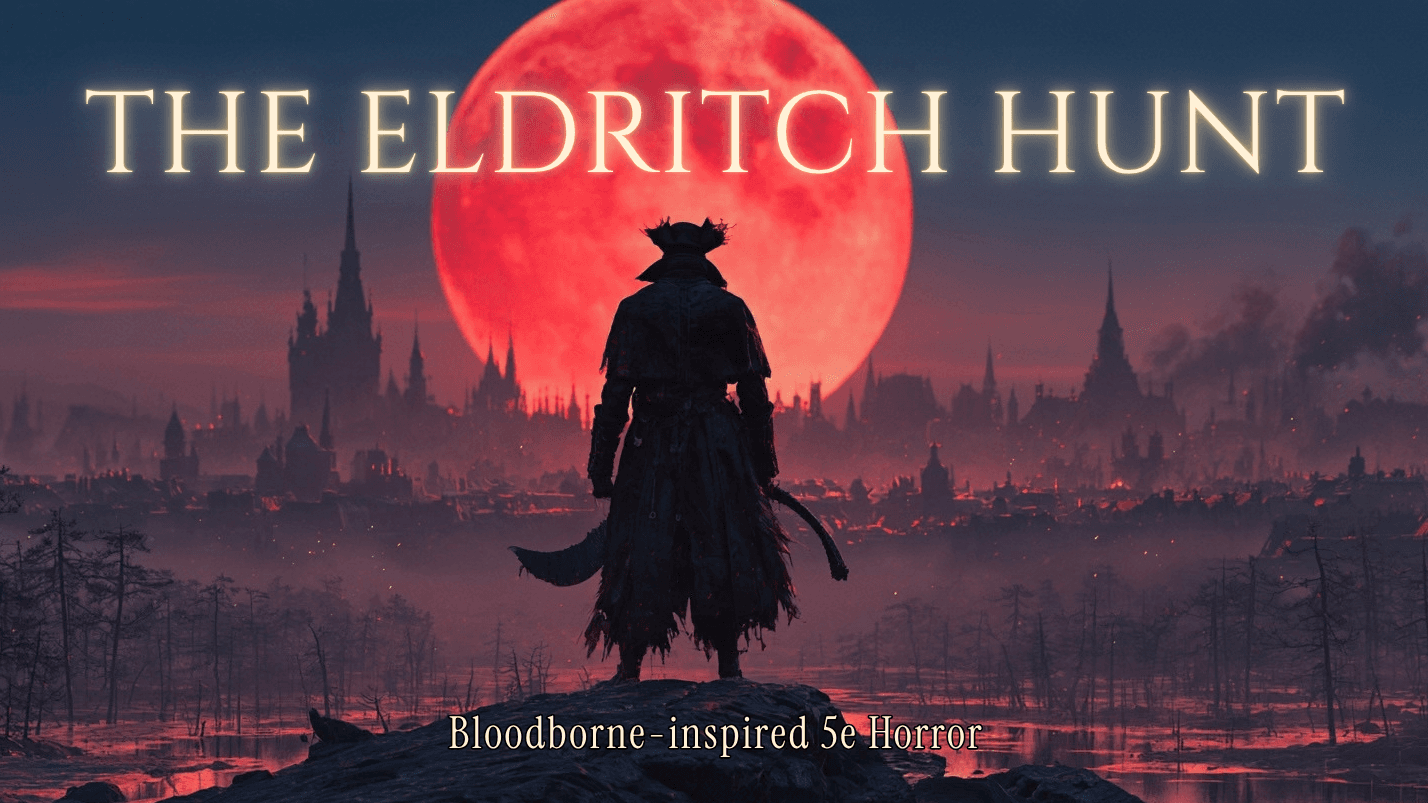
The Eldritch Hunt — Bloodborne-inspired 5e Horror
The blood moon hangs low, and beasts rule the streets. Take up the blade, but beware — whoever fights monsters may become one.
$25.00
/ Session
Details
2 players following this game
Weekly / Monday - 8:00 PM UTC
Session Duration / 3–4 hours
Campaign Length / 50–73 Sessions
2 / 6 Seats Filled
Top Game Master
One of StartPlaying's top-rated GMs, a player favorite and highly recommended.

Report Adventure

StartPlaying Money Back Guarantee
If your game doesn't happen, we guarantee a refund. Just reach out to StartPlaying Support. Refund Policy
Meet your party members
2/6


About the adventure
If you've ever wanted to play Bloodborne at a D&D table, this is that game. We're running Steinhardt's Guide to the Eldritch Hunt in the cursed city of Luyarnha — play a Jaeger, the guide's own hunter class, or one of its stranger options. Trick weapons shift shape mid-swing, eldritch moons warp the city night to night, and every truth you uncover costs you a piece of your mind. Sessions run on the hunt: you push deeper into the city's districts, and the beasts you meet punish carelessness. Combat is tactical and genuinely dangerous — trick weapons reward players who think about timing and positioning. Between fights, you'll piece together what's happening to the city, and the deeper you dig, the stranger it gets. This is horror, so expect dread, body horror, and madness that leaves a mark — insight is power here, and it costs you. Real consequences, but never at your expense: we run a session zero, set lines and veils together, and use safety tools at the table. Character death is on the table; being blindsided isn't.
Game style
Combat Heavy
Rule of Cool (RoC)
Game themes
Meet the Game Master

5.0
(16)
1 year on StartPlaying
25 games hosted
Highly rated for: Storytelling, Beginner Friendly, Knows the Rules
Average response time: 2 hours
Response rate: 100%
About me
From the moment I discovered D&D, I knew I wanted to be a Game Master. I love creating immersive worlds filled with mystery, intrigue, and meaningful choices—and then collaborating with players to bring those worlds to life. For me, the most exciting moments at the table happen when characters are pushed beyond the obvious solution and players discover who their characters truly are when faced with difficult decisions. My games are driven by story and character, with a strong focus on roleplay, social dynamics, and player agency. I enjoy crafting scenarios where choices matter, relationships evolve, and the world responds authentically to the party’s actions. Combat is present and purposeful, but it always serves the narrative rather than existing for its own sake. Above all, I aim to create a welcoming, respectful table where players feel comfortable taking creative risks, engaging deeply with the story, and investing in their characters. If you’re looking for a GM who values collaboration, narrative depth, and memorable moments, I’d love to have you at my table.
View Profile →Character creation
Creating your character
Characters are built together in session zero, before play begins — bring a concept, not a finished sheet. We're on 2014 fifth edition rules, starting at level 3. Stats by standard array or point buy, whichever you prefer. You'll have the full 2014 Player's Handbook plus every player option from Steinhardt's Guide to the Eldritch Hunt — the Jaeger hunter class, its races, subclasses, backgrounds and trick weapons. You don't need to own the book; I'll walk you through what's on the table. We build in Foundry, not D&D Beyond. The D&D Beyond version of Steinhardt's is the 2024 conversion, and we're staying on 2014 so everything slots together cleanly. No 2024 PHB options, please.
What to expect
Preparing for the session
Discord — free account, and join the server I'll send you. This is where we talk during sessions and between them. The Forge — free account at forge-vtt.com. That's where our Foundry game lives; you'll play in your browser, so there's nothing to install. A working mic — a headset or anything that isn't your laptop's built-in mic, ideally. A webcam if you have one — not required, but cameras on makes the table warmer and the scary bits land harder.
What Ink & Iron brings to the table
Full Foundry setup. Custom maps with dynamic lighting, ambient music and soundscapes, tokens and handouts prepared for every scene. Trick weapons are automated — transform your weapon mid-fight with a click, no rules-lawyering mid-turn. Roleplay and combat in equal measure. I don't run a dungeon crawl with dialogue bolted on, or a talking game with occasional fights. Expect both, properly prepped. NPCs get voices and their own agendas, and combat is tactical and genuinely dangerous — positioning and timing matter, and the beasts fight to win. Rule of Cool, within reason. If you describe something brilliant, I'll find a way to let it work. What I won't do is let a clever ruling in session four break the game in session twenty.
Homebrew rules
Trick weapons. Your weapon has two forms and swaps between them mid-combat, each with different damage, reach and properties. Firearms. Flintlocks and blunderbusses, Madness. Insight has a price. Witnessing the truly wrong inflicts short-term, long-term or indefinite madness, and the worst of it doesn't wear off on a long rest. Eldritch moons. The moon changes the rules of the night. A scorching moon drives the city mad; a glacial one freezes it. You'll learn to read the sky before heading out. Losing limbs. Some monsters take pieces of you. Not a death sentence, but the city has surgeons, and they aren't cheap or kind.
Equipment needed to play
Internet
Computer
Microphone
Platforms used
Safety
How Ink & Iron creates a safe table
"Session zero. Before we play, we go through tone, content and expectations together, and build characters as a group. I send a lines and veils form beforehand so you can flag anything privately rather than say it out loud to strangers. Lines and veils. Lines are what we keep out of the game entirely. Veils are what can happen, but off-screen. You can add either at any point in the campaign, and you never have to explain why. Breaks. We take a proper break every session, and we'll pause any time someone needs it. In a horror game that isn't a luxury — stepping out of it for five minutes is how you stay able to enjoy it. Bleed. Horror sticks to you. When your hunter loses their grip, some of that can follow you out of the session, and that's normal rather than a failure. We name it when it happens and talk it through instead of pretending the game stops cleanly at the character sheet. Stars and wishes. We close each session with a star — a moment you loved — and a wish for something you'd like to see next. It takes two minutes and it's how the campaign bends toward what the table actually enjoys. Aftercare. We decompress together at the end, out of character. If something landed badly and you'd rather not raise it with the group, message me and I'll adjust quietly. This is a horror game and it's meant to unsettle — body horror, madness and loss of self are the setting. But there's a difference between frightening and harmful, and the above is how we stay on the right side of it."
Content warnings
Safety tools used