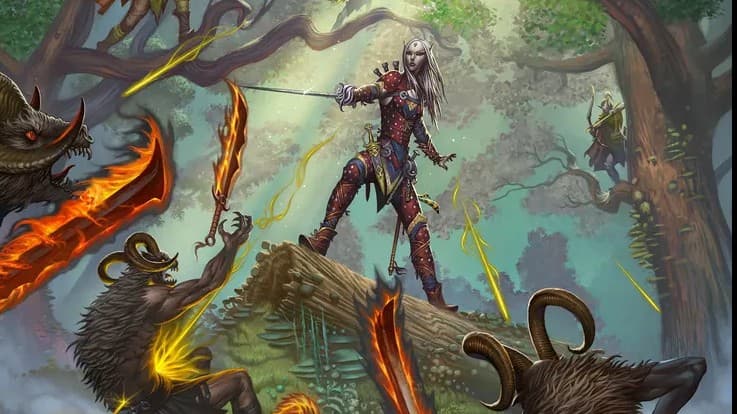
The last elven defense: Spore War
Chosen as Kyonin’s diplomats, you uncover Treerazer’s creeping blight - then lead the fight against Tanglebriar’s demons.
$20.00
/ Session
Details
Weekly / Thursday - 10:00 AM UTC
Session Duration / 3–4 hours
Campaign Length / 30–50 Sessions
0 / 5 Seats Filled
Report Adventure

StartPlaying Money Back Guarantee
If your game doesn't happen, we guarantee a refund. Just reach out to StartPlaying Support. Refund Policy
About the adventure
Spore War is a high-level Pathfinder 2e campaign set in the elven nation of Kyonin, where a long-simmering threat is about to boil over: the demon armies of Tanglebriar, ruled by the nascent demon lord Treerazer, are moving toward open conflict. You begin as established heroes asked to serve as diplomats at an important summit—then events escalate into dangerous missions, investigations, and battles as the truth becomes impossible to ignore. This AP isn’t just “kick in the door.” Early on, it’s relatively combat-light and leans into politics and social play, and the campaign regularly uses structured challenges like Influence, Infiltration, and Research (Victory Point-style subsystems). If you like mixing smart choices, tense scenes, and tactical fights, this one delivers. Power-wise, this is a level 11 → 20 story, so characters feel capable from the start and grow into legends. To support that heroic vibe, we’ll be using a few variants: Free Archetype (no feat restrictions), Ancestry Paragon, and Gradual Ability Boost.
Game style
Realm Building
Combat Heavy
Tactical / Crunchy
Roleplay Lite
Meet the Game Master

5.0
(4)
3 years on StartPlaying
2 games hosted
Highly rated for: Creativity, Teacher, Sets the Mood
Average response time: 7 hours
Response rate: 100%
About me
Hello! My name is Eduard, but most people call me Eddie. I'm 31 years old. I’ve been playing TTRPGs for about 8 years (DnD 2e, DnD 5e, and mostly Pathfinder 2e), and I’ve been GM-ing Pathfinder 2e for the past 2.5 years. I enjoy leaning into the tactical depth of PF2e: tight encounter design, meaningful positioning, and rules that reward smart choices. I’m very comfortable with the system, and I like helping players get the most out of their builds without slowing the game down. Professionally, I’ve been a software developer for 8 years, and I’m now pivoting into becoming a full-time professional GM. I bring that technical mindset into Foundry VTT with robust automation, clean character and monster setups, and clear visualizations of effects, auras, and conditions. My goal is to let the rules shine: crunchy, fair, and consistent—while still leaving plenty of room for strong character moments and story development. I’m all about collaborative storytelling, weaving player backstories into the world, and creating memorable character moments that stick with you long after the session ends—whether that’s a tense moral dilemma, a hard-earned victory, or a quiet scene around the campfire. If you’re looking for a GM who loves both system mastery and character-driven stories, I’d be happy to welcome you to my table.
View Profile →Character creation
Creating your character
We’ll do character creation in a Session 0 (or you can build ahead and we’ll review together). Characters start at level 11 and should have a clear reason to care about Kyonin—ideally a connection to Greengold and/or a personal stake in protecting the region. How to build: I recommend Pathbuilder (pathbuilder.com) to keep high-level building manageable. We’ll make sure your defenses, skills, and action options are solid so you feel good at the table from session one. Stats: Use the normal PF2e creation rules, plus Gradual Ability Boost (you’ll gain ability boosts more steadily over levels instead of in big “every 5 levels” bundles). Variant rules we’re using: Free Archetype (no feat restrictions): you’ll get extra archetype feats, and we’re not enforcing the usual “must take X feats before another dedication” style limitations—build the concept you want. Ancestry Paragon: extra ancestry feats over the campaign, so your heritage stays relevant at high level. Allowed rules/books: The AP uses Remaster assumptions—Player Core / Player Core 2 are the baseline. Other Paizo options are fine if they’re not disruptive, but run anything uncommon/rare by me first so we keep party power and tone aligned. Starting gear: Since we start at 11, we’ll use one of the guide’s “fresh 11th-level” gear methods as a group (simple and fair).
What to expect
Preparing for the session
You should have: - A discord account - A microphone - A browser that can run FoundryVTT.
What Eduard brings to the table
Foundry VTT with clear visuals: maps, tokens, measuring, effects, and handouts so you always know where you are and what’s happening. A table that keeps things moving: I’ll default to rules-as-written, but I’ll make quick calls when needed and look things up after the scene. Tactical combat with teamwork encouraged (and help with options on your turn—high-level PF2 has a lot of options). Roleplay-forward NPCs (light voices/accents when it fits) and optional ambient music. Support for the AP’s non-combat play: I’ll explain Influence/Infiltration/Research scenes clearly so they feel like gameplay, not homework.
Equipment needed to play
Internet
Computer
Microphone
Platforms used
Safety
How Eduard creates a safe table
Tools at the Table We’ll use a mix of written and “real-time” tools: Lines & Veils (pre-game): You’ll be able to mark topics as: Line: never appears. Veil: can exist, but is glossed over or off-screen. X / N / O system (in play): Since we’re online, these will be digital, not physical cards: X: “Stop. I’m not okay with this.” You can type X in chat or DM me. I will immediately pause, rewind a bit, and redirect the scene—no questions, no pressure to explain. N: “Not now / let’s ease off this.” You can type N or something like “Let’s move on from this topic.” I’ll soften or pivot the scene. O: “I’m good to continue, even if I seem upset.” You can type O if we’re in intense territory but you’re enjoying it and want to push on. You are always free to step away from the table briefly. Just say “BRB” or DM me, and we’ll work around it.
Content warnings
Safety tools used