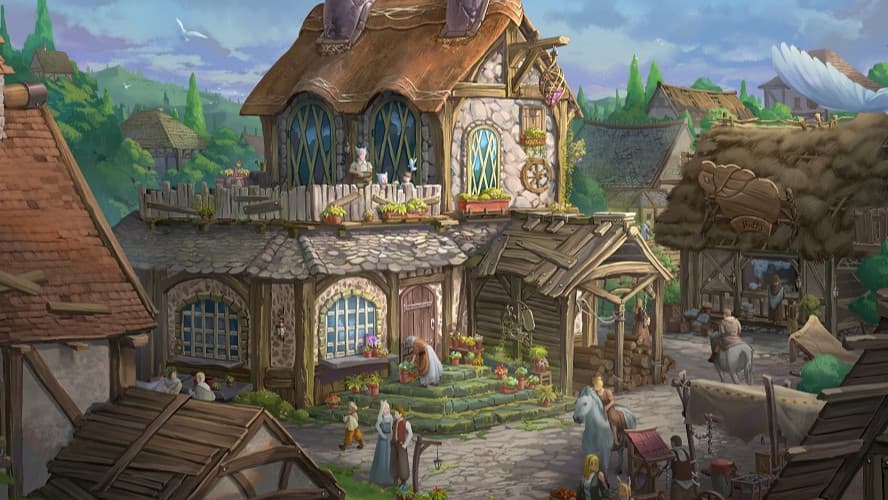
Image by From the startplaying free game art collection.
Familiar Heroes - D&D 3.5e Familiars Game
A wizard's familiar isn't supposed to be the hero of the story. But when their masters vanish, these very little adventurers have very little choice.
$15.00
/ Session
Details
Weekly / Wednesday - 5:00 PM UTC
Session Duration / 2–4 hours
Campaign Length / 8+ Sessions
0 / 5 Seats Filled
Report Adventure

StartPlaying Money Back Guarantee
If your game doesn't happen, we guarantee a refund. Just reach out to StartPlaying Support. Refund Policy
About the adventure
Dungeons & Dragons 3.5e - Familiars Game Something has gone terribly wrong. You awaken in the burning remains of your masters' laboratory with no masters in sight, and more troubling, you are still aware. You are familiars. You aren't meant to be adventurers, heroes, or anything more than magical companions to your masters. Yet some strange power now courses through you, granting abilities you should not possess. Where is this otherworldly power coming from? Where are we? Where are our masters? Did I mention the room is still on fire? -- This is a D&D 3.5e Forgotten Realms adventure set in DR 1372 (around the era of Neverwinter Nights and Baldur's Gate 2), with a strong emphasis on character-driven roleplay, exploration, mystery, and occasionally ridiculous situations. You will play the familiar of a missing spellcaster: cats, ravens, rats, owls, toads, lizards, or other appropriate creatures are all possibilities. I am very much open to odd requests. That familiar will have all default abilities of a familar, including at least one extra ability: the magical effect that is causing you to remain sentient and still connected to your master allows you to tap into that wizards cantrips (spells possibly) as if the master were nearby. Your character begins as a simple familiar, but the strange circumstances surrounding your master's disappearance mean that you may become something more. As the campaign progresses, you may develop new abilities, acquire character class levels, and eventually become a genuine adventurer in your own right. The rules, it should be noted, say that an animal can use equipment if the animal is capable of doing so. Imagine a little raven paladin, with a teensy set of lamellar armor calling upon Ilmater to smite an undead rat with a custom made beak-sword. The tone will be lighthearted fantasy adventure with an underlying supernatural mystery. Expect plenty of opportunities for silly animal hijinx, like figuring out how a cat picks a locked door, convincing a shopkeep that this isn't a prank and I do really need to buy a tiny sword, or discovering that a party of tiny creatures has very different ideas about "adventuring equipment." But beneath the comedy is a genuine Forgotten Realms story involving ancient magic, Ancient secrets, something very old and very evil working its dark powers against life itself. This game is intended for players who enjoy roleplaying and collaborative storytelling as much as combat. You do not need to be an expert on Forgotten Realms or D&D 3.5e, in fact, I style all my games around being newcomer friendly experiences. What matters most is being willing to embrace the premise, contribute to the group's story, and have fun playing a very unique character. Most commoners look at wizards and their familiars as wizened eccentrics toting around strange pets they mutter to while poring over an old tome. Let's show them that tiny things can make big waves.
Game style
Roleplay Heavy
Sandbox / Open World
Theater of the Mind
Game themes
Meet the Game Master
5.0
(6)
Less than a year on StartPlaying
3 games hosted
Highly rated for: Creativity, Rule of Cool, Storytelling
Average response time: 21 hours
Response rate: 100%
About me
Well, hello there. I'm Daz. I've been playing tabletop games for 25 years, and I've been GMing regularly for about 20 of them. At this point, I've come to realize that I didn't really choose to GM. I have to. I _must_ It's much the same with writing: the ideas get into my head, and eventually they simply have to get out. My first games were a few rinky-dink affairs in high school, followed by my first *real* campaign in college with a few dear friends. Before long, I found myself imagining worlds of my own, strange characters with interesting backstories, settings, narrative arcs, and wild ideas that didn't quite fit into any existing box. So I decided to test my mettle and run a game for those same friends. We played a game that was a mix of Animal Crossing and Silent Hill. It was horrifying. But lots of fun! Twenty years later, I'm still at it. For most of those two decades I've been concocting plots behind my screen, running games across a wide variety of systems and settings. Along the way, I've become something of a student of the hobby itself: I love digging into the history of settings, understanding how mechanics have evolved, and figuring out what the intention was behind which dice are rolled. More importantly, I've learned that a good GM isn't simply the person who knows the rules or tells the story. A good GM makes it easy for everyone else to participate in creating the experience. That's something I've worked hard to develop over the years. I enjoy teaching systems by playing them rather than burying new players beneath a rulebook. I like games where the players and GM can actually talk to one another, reach a communal decision about what will make the game more fun, and then get on with absolutely annihilating the plot points I had planned for. I've developed guidelines and approaches that let players engage as deeply as they want to, whether that's bringing a character that is a challenge for the player to the table, or trying a bit of high RP when its a bit outside the players comfort zone. And while I certainly love a good fantasy campaign, I've spent much of my time GMing branching out. Cyberpunk. Low Magic. High Lethality. Grimdark. Heartwarming (Princess: The Hopeful anyone?). Some of the most fun games I've run recently have been one-shot campaigns inspired by movies, television, video games, and books. Both from things I discovered recently to things I loved when I was younger. How I would character myself being is GM is: An experimenter empath who tries to help the players tell the story they want to weave. I like discovering what happens when you take an idea seriously. I like finding the weird corner of a setting that nobody thought to explore. I like watching players take something I prepared, turn it sideways, and come up with something I never expected. (::sound of me dumping my session notes in the trash::) After 25 years, I'm still fascinated by this hobby. I still have worlds I want to build, stories I want to tell, systems I want to try, but also potentially develop. Probably with your help. So if this sounds like your kind of table, I'd love to have you along for the ride.
View Profile →Character creation
Creating your character
You begin the campaign as a named familiar with some memory problems. You know you are a familiar. You know your master is in trouble. You know familiars aren't meant to survive indefinitely without their masters before reverting to normal animals. And you know that, somehow, you may be your master's only hope. Firstly, choose an appropriate familiar from any official D&D 3.5e sourcebook. Creatures from Dungeon, Dragon, third-party material, or homebrew may be possible, but ask the DM first. You can, of course, select templates or other feats from your master, and while they'll be narratively present, but their effects may not all be unlocked until later. I will have a full list of the official familiars available and all the templates I can find on this games discord for you to look through. At the start, you receive the normal mechanical benefits of being a familiar, including its increased Intelligence and other abilities based on your master's character level (We're starting at master level 1-2 for the master, but that number goes up quickly). Don't worry too much about being powerful enough. You'll be balanced against your foes, and circumstantial bonuses from preparation will change the tides of battle. You are also Awakened in the broader sense of the campaign premise. You are a fully independent, self-aware player character capable of reasoning, making decisions, and communicating where your creature's abilities permit. This is a campaign conceit rather than a strict application of the Awaken spell, allowing even creatures like spiders or other normally unsuitable familiars to function as player characters. Your creature's natural strengths and weaknesses still matter, but nobody should be mechanically punished for choosing an unusual or fun concept. After everyone has selected their creature and any approved templates, the DM will adjust ability scores so that the characters are roughly equivalent to the same point-buy value. Familiars are able to speak to their masters, others of their kind, and anyone with Speak to Animal. You might not speak common at first, but you can have additional languages if your Intelligence is high enough. In other words: pick the creature you want to play first. We'll make the numbers work afterward. Finally, create the spellcaster who was your master. You do not need to fully stat them unless you want to. They must have sufficient levels to legitimately acquire a familiar, but they may have other class levels as well. As the campaign progresses, your master's other abilities may manifest in you as strange bonuses, powers, or eventually even class abilities. Your master is an important NPC, not your character. Give them a name, personality, occupation, and a few details about your relationship with them. Were they a beloved companion, eccentric employer, reluctant caretaker, demanding teacher, spoiled-pet owner, or something else entirely?
What to expect
Preparing for the session
I typically run voice over Discord, I'll be making a server specifically for this game, its the most stable I've found for VoIP. And I run rolls on Roll20 typically. But dice as you know, are fickle, and if dice rolls are not random-seeming enough on Roll20, I also allow dicebots on discord or any other public facing dice roller. For D&D 3.5e, there are numerous methods of charsheet, they are all more or less allowed. I've personally enjoyed excel sheets, but right now my favorite is an auto filling 3.5 pdf I have and can share. As long as we have a sheet that shows everything important, I will accept a notepad text file (and I actually have.) as long it's complete. If you happen to be brand new, that is absolutely not a problem at all! I'll walk with you through the steps of the sheets, the system, and general play. Genuinely, it takes about a gameplay session to go through everything in 3.5 and even then, there are things even I have never personally run into. We are all learning. In the case that you are new and do not want to engage with building your own sheet, excel, or any other automated methods. It can be intimidating, I know. You can just chat with me for ten minutes and we can knock one out very quickly. Or you can ask for a premade character if you like. I can create nearly anything we chat about very easily. I'll send you the finished PDF and we'll be set to roll.
What Dazzle brings to the table
You can expect us to have a free session 0 which might come individually with just us speaking over voice chat. We'll probably be typing messages now and then as well. Session 0 can be chargen and preluding, but we can do that separately. If a group session 0 is possible, it may seamlessly move into a session 1 if there is time left over (still free until the next session). During that time, we'll be chatting about your expectations, what kind of story you might want to have, what kind of story you DON'T want to have, discussing the character or characters you are bringing to the table. Make last minute adjustments to your sheets like freebies and unique attributes you might have from your past. Maybe a storytime if anyone has a cool story to tell about TTRPGs (I have a collection). tldr: First session is free. Whether that session is Session 0 stuff, or if we did that already over text or one on one. If we accomplish all Session 0 stuff already, then Session 1 is free. Lastly, this is D&D, full party wipe is possible but not intended. Sometimes you, the player knows something your character does not, acting on it is what we call metagaming. Sometimes there is something your character would know but you, the player, do not. Thats also quite normal and isn't metagaming. If there is something your characters would know is lethal, I will let you know it. If your characters would reasonably think they are walking into a deathtrap, I'll tell you that. And there is always the ever popular GM motto: "Are you sure you want to do that?" D&D 3.5e has rules. We'll follow them generally, and if we find any problems, we'll take a minute to discuss. If there is ambiguity or a failure in how the rules deal with a situation, my philosophy is that we discuss how the letter of law may have failed, and what change would suit the spirit of the law, if the spirit is also insufficient then we discuss and agree as a group what new rule feels fair for all involved. I very much prefer consensus for making those big decisions and I will not be surprising you with them. I am mostly rules as written oriented, but I am known to be rule of cool when it's called for. But we will be somewhere between the two. Sometimes there are things that the game system does not have rules for. For that, we will discuss. Most games, and even D&D, specifically state in the manual that the rules are meant to be a stepping stone to fun and can be changed or discarded when they get in the way of said fun.
Homebrew rules
If I ask you to roll dice and I say the words, "Just don't roll a critical failure." and then you roll a critical failure, you are allowed to cuss me out. Crits explode. If you roll a 20, roll again to confirm, hit a 20? Guess what. Roll again. Another 20? Keep rolling. After the third 20, I start adding orders of magnitude. Same for crit fails, but I fully admit, I'm much softer touch on them. This is negotiable, we do not have to do it, but I've found is a source of a great deal of fun. I just want to reference back to consensus based rule alterations when required, only when they are required.
Equipment needed to play
Internet
Computer
Microphone
Platforms used
Safety
How Dazzle creates a safe table
I do not have a physical NO-card to put down in front of everyone, but I can have one on the roll20 board. I have a direct message with all players. And simply stating "Veto" or some version of "I'm not comfortable with this" will illicit me to move on from the scene or merely abstract the events down to the necessary story bits prior to the moving on. Session 0 is typically as far as I've ever needed to go for the tempering and setting of expectations from everyone. I'm very accommodating. And if you are uncomfortable by any subject, let me know your limits whenever you feel comfortable sharing them. I can voice them as if they were my own to everyone else. And we'll probably agree on those limits anyway. I tend to shy away from gratuitous descriptions of the unpleasant or grotesque if they aren't completely necessary. Basically, anything down in the content warnings is negotiable. It's D&D, some violence is expected.
Content warnings
Safety tools used