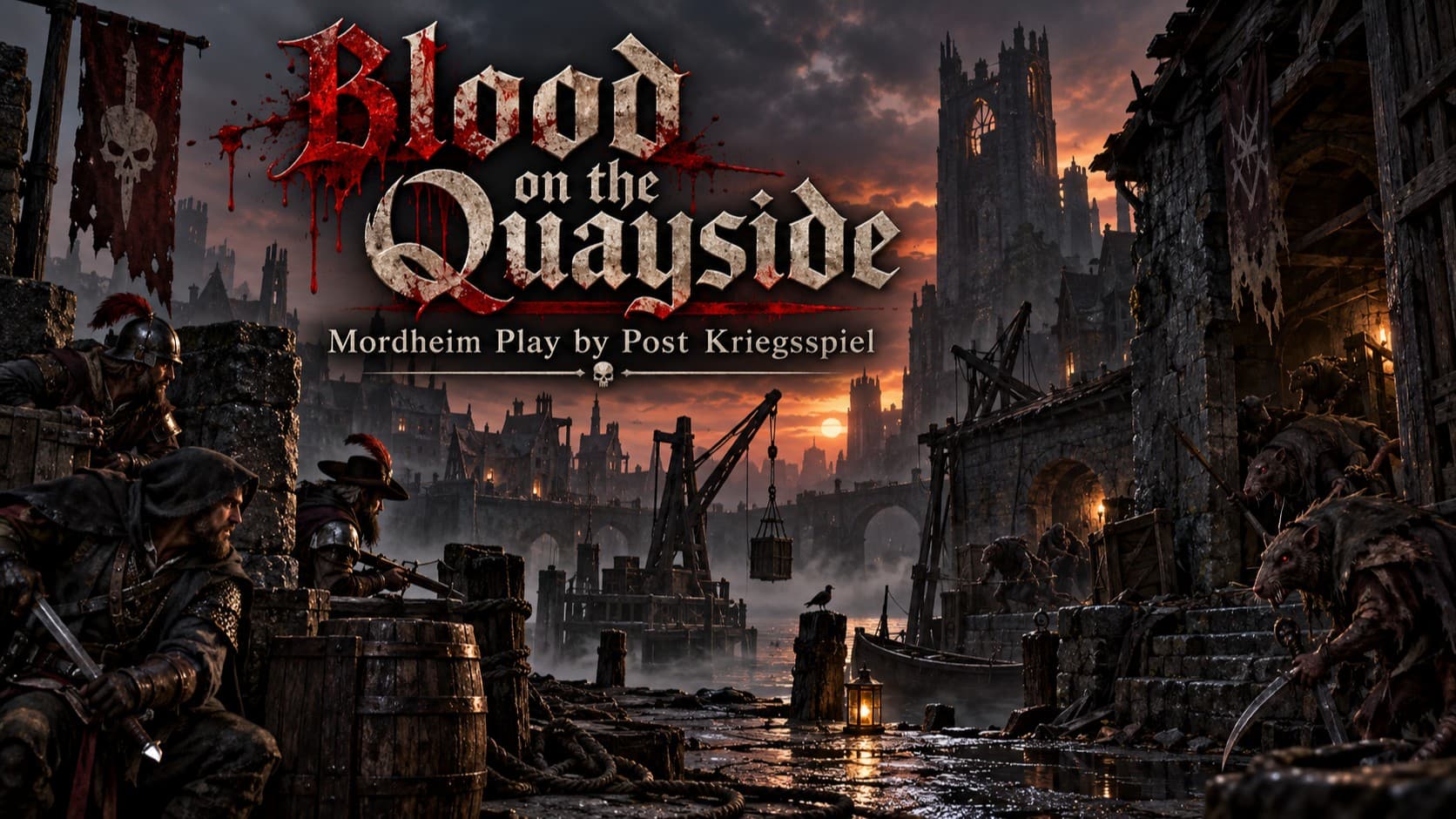
Blood on the Quayside | A Warhammer Fantasy Mordheim Skirmish
A mercenary company must infiltrate a Skaven-infested quayside on a secret mission—before the ratmen discover them and close in.
TYPE
SYSTEM
LANGUAGE
EXPERIENCE
AGE
$10.00
/ Session
Details
1 player following this game
Play by Post (Asynchronous)
Billed Weekly / Monday - 5:00 PM UTC
Session Duration / 1 hour
Campaign Length / 1–4 Sessions
0 / 6 Seats Filled
Report Adventure

StartPlaying Money Back Guarantee
If your game doesn't happen, we guarantee a refund. Just reach out to StartPlaying Support. Refund Policy
About the adventure
Blood on the Quayside is an umpire-led Warhammer Mordheim skirmish played over Discord. This is a 5 turns a week asynchronous Play-by-Post campaign. The $10 price covers each week of the event up to a maximum of 4 weeks. The expectation is the campaign will last between 3-4 weeks. As umpire, I run the battlefield privately using Tabletop Simulator. This allows me to track the positions and movements of forces, resolve encounters, and maintain the fog of war. A mercenary company has been sent on a secret mission into a dangerous quayside district of Mordheim. Before they can achieve anything, they must first find a way inside, move through unfamiliar streets and avoid attracting too much attention. Below them, the Skaven control tunnels, cellars and hidden routes beneath the district. As signs of intrusion begin to appear, the ratmen must investigate, identify the threat and defend their territory. Players command individual mercenary captains or Skaven leaders together with their small groups of followers. You will decide where to move, what to investigate, when to hide, when to fight and whether the information reaching you can be trusted. There is no shared battlefield view and no perfect knowledge. You know only what your character can see, hear or learn through others. Orders are sent privately to the umpire, who resolves movement, encounters and combat before returning an individual report describing what your character experiences. The two sides begin with very different information and objectives. The mercenaries know why they have come but not what awaits them inside. The Skaven know their territory but must discover who is approaching and what they intend to do. The campaign lasts for a maximum of 20 turns or 4 weeks, allowing the situation to develop from cautious infiltration and investigation into pursuit, ambushes, desperate fighting and, potentially, a bloody struggle for control of the quayside.
Game style
Combat Heavy
Play By Post
Roleplay Lite
Game themes
Meet the Game Master

5.0
(8)
Less than a year on StartPlaying
Highly rated for: Storytelling, Beginner Friendly, Inclusive
Average response time: 2 hours
Response rate: 100%
About me
I’m Pete ‘the Elder’, a long-time GM and tabletop wargamer with decades of experience running one-shots and campaigns across fantasy, sci-fi, modern, and historical settings. I discovered Kriegsspiel years ago and loved what it does best: fog of war, meaningful decisions, and consequences that emerge naturally from play. These days I blend Kriegsspiel-style adjudication with roleplay to create games where you’re placed in tense situations, given imperfect information, and asked to make real choices under pressure. If you enjoy grounded worlds, tough calls, and stories shaped by what you do at the table, you’ll feel right at home in my games.
View Profile →Character creation
Creating your character
There is no traditional character creation for this event. This is a Kriegsspiel-style play-by-post campaign set in the ruins of Mordheim. Rather than building a character sheet from a rulebook, each player will take command of a named character within the unfolding scenario. Your role, abilities, equipment, starting position, and immediate objectives will be provided before play begins. Players will not need to know the Mordheim rules in detail. The GM will handle the hidden mechanics, movement, combat resolution, morale, uncertainty, injury, and consequences behind the scenes. Your job is to make decisions from your character’s point of view: what you do, where you move, what risks you take, what orders you give, and how you respond to incomplete information. Before the game starts, I will provide each player with: event setting, character and faction briefings, their current situation, what they can see, hear, and reasonably understand, any allies or subordinates under their control, and their immediate objectives. The emphasis is on decision-making, tension, atmosphere, and the fog of war rather than character optimisation.
You´ll take one of two character types, specialist and commander. A specialist can be a champion, a scout, or a marksman. Champions tend to be the best fighters in the faction, Scouts are excellent at finding the enemy and ambushes and Marksmen tend to be the best with ranged weapons. Commanders can as be good at these things, but their main focus is on commanding general fighters of the company or warpack. Commanding characters can give orders to specialist and more senior commanders can give orders to other commanders as well.
What to expect
Preparing for the session
Players will need access to Discord, as the game will be run primarily through private and group Discord channels. You do not need to own Mordheim, Warhammer, or any specific rulebook to take part. Familiarity with dark fantasy, tactical games, roleplay, or play-by-post games will help, but is not required. New players are welcome as long as they are happy with a slower, written, decision-focused style of play. Before play begins, players should: Join the Discord server. Read their private character or faction briefing. Read the short “How the Game Works” guide. Ask any questions before the first turn begins. Be ready to post clear written orders or intentions when prompted. This is an asynchronous play-by-post event. You will not need to attend a live voice session each week. Instead, turns will be processed over time, with players submitting actions, orders, messages, or decisions through Discord. Players should be prepared for uncertainty. You will not always know exactly where enemies are, what allies are doing, or whether your information is complete. That is intentional and central to the Kriegsspiel style.
What Pete the Elder brings to the table
I will provide the full scenario, setting, briefings, maps, images, tactical updates, and all hidden adjudication. You will receive character-specific reports written from your point of view, describing what your character can see, hear, suspect, and understand. These reports will often include uncertainty, partial information, danger, and the consequences of your choices. I will handle the rules and mechanics behind the scenes, including combat, movement, morale, injuries, hidden enemies, timing, visibility, and the wider situation. Players do not need to calculate modifiers or manage a full rules system. I will also provide: private Discord channels for individual characters or factions, temporary shared channels when characters meet or communicate directly, atmospheric battle reports and scene descriptions, maps or images where useful, tactical consequences based on player decisions, and a living, reactive scenario where the situation develops through play. My GM style is atmospheric, tactical, and consequence-driven. Expect tension, danger, difficult choices, incomplete information, and moments where caution, speed, bravery, or sacrifice may all matter.
Homebrew rules
This event uses a Kriegsspiel-style adjudication system rather than a player-facing rules engine. Players do not need to know or manage detailed mechanics. I will handle movement, timing, combat, morale, injury, visibility, communication, and hidden information behind the scenes. Your responsibility is to make clear decisions from your character’s point of view and explain what you are trying to do. The most important table principles are: Fog of war matters. You will only be told what your character can reasonably see, hear, know, or infer. Orders and intentions matter. Clear, practical actions are better than highly complex plans. Time and position matter. Movement, hesitation, terrain, distance, and communication delays may all affect what happens. Consequences are grounded. Armour, cover, morale, numbers, wounds, fear, surprise, and leadership all matter. The GM resolves uncertainty. When an outcome is unclear, I will adjudicate it fairly using the hidden situation, character ability, terrain, risk, and chance where appropriate. This is not a competitive rules-lawyering game. It is a tense, atmospheric command-and-decision game where players act under uncertainty and discover the consequences through written reports.
Equipment needed to play
Internet
Computer
Platforms used
Safety
How Pete the Elder creates a safe table
This is a gritty fantasy game with danger, violence, fear, uncertainty, and horror atmosphere, but player comfort comes first. Before play begins, I will ask players to share any Lines and Veils they want observed. A Line is content that will not appear in the game. A Veil is content that may exist in the story but will fade to black or be kept off-screen. Players can send these privately by message if they prefer. Because this is a play-by-post game, safety tools will be handled digitally through Discord messages. Players can contact me privately at any time if something in the game needs to be adjusted, softened, skipped, or removed. I use an Open Door policy: players may step away, pause participation, or leave the game without needing to justify themselves. Real life and player wellbeing come first. The game may include grim scenes, injury, fear, monsters, ruined urban spaces, and difficult tactical choices, but it will not include graphic sexual content, sexual violence, torture-focused play, or real-world hate directed at players or protected groups. After intense moments, I am happy to check in with players and debrief if needed. My aim is to create a tense, immersive, dangerous story while keeping the table respectful, fair, and enjoyable.
Content warnings
Safety tools used